
Hong Kong’s feminist backslide
Sexually explicit deepfake images targeting overseas Hong Kong activists were sent to the UK and Australia in recent months, in a new wave of transnational harassment that has raised questions about sexism and the state of gender equality in a city transformed by sweeping national security crackdowns.
Photos circulated showing the face of Carmen Lau, a pro-democracy activist exiled in the UK, superimposed onto images of women who were naked or wearing underwear. These images were enclosed in letters falsely purporting to be from Lau and sent to her former neighbours. The letters, which included Lau’s former address, suggested Lau was a sex worker who invited people to her home.
Former Hong Kong legislator Ted Hui’s wife has also been targeted. Posters showing an old photograph of the couple bearing the headline “Hong Kong lonely housewife”, portraying Hui’s wife as a sex worker were emailed to Hui’s boss and posted to residents at and around the address in Adelaide stated on the poster, which Hui said was unrelated to him.
“I am a woman, and they threaten me like this”, Lau told The Guardian, adding that she was “terrified” by the letters. She described the campaign as “an escalation of transnational repressing” that used AI or digital tools to specifically target women.
Gender as a weapon of repression
Gendered political smears have long been used as a tactic to discredit Hong Kong’s pro-democracy movement. At the height of the 2019 protests, Fanny Law, a senior adviser to then-Hong Kong Chief Executive Carrie Lam, made unsubstantiated claims that young women were offering “free sex” to frontline male protesters.
At the same time, allegations of sexual violence by Hong Kong police against protesters sparked public outrage. Footage showing male police officers grabbing a female protester’s limbs and exposing her underwear circulated widely online. In a separate incident, a protester accused a female police officer of conducting an unnecessary strip search and using a pen to force her to spread her legs inside a police station.
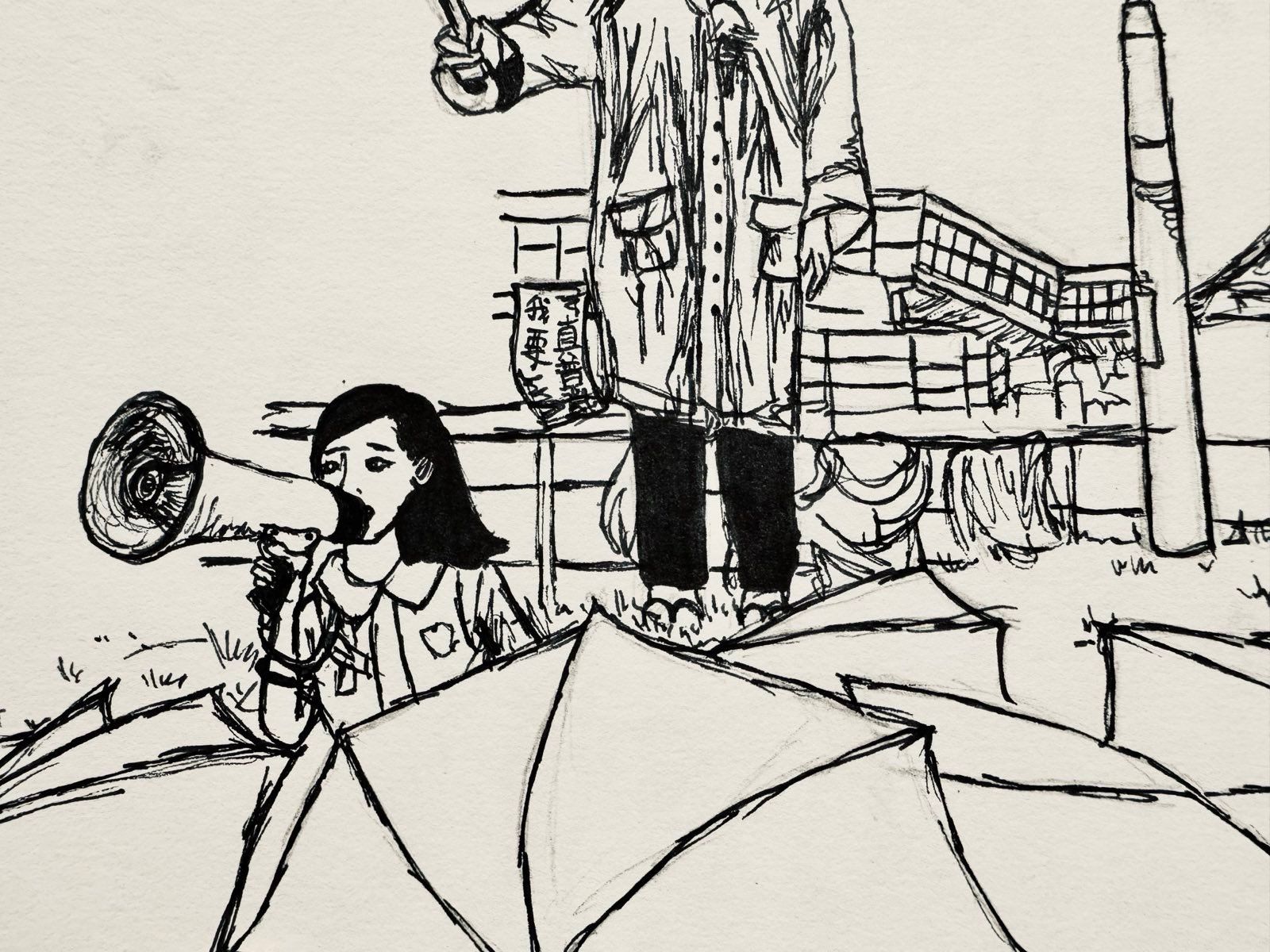
In August 2019, thousands of people attended an anti-sexual harassment rally in the city centre to stand with the women involved in the two incidents and to protest against sexual misconduct by the police. The rally was organised by the Hong Kong Women’s Coalition on Equal Opportunities (WCEO), a coalition of pro-democracy women’s organisations considered more progressive and vocal in advocating women’s rights and gender equality.
Some participants wrote “#ProtestToo” on their forearms with lipstick, echoing the #MeToo movement which has swept the globe since 2017 but received limited public attention in Hong Kong prior to the 2019 protests. The rally marked a turning point in public discourse, heightening awareness of the use of sexual violence and gendered disinformation as tools of political repression.
Silencing
But the rally’s momentum could not be sustained. Calls for an investigation into sexual violence and accountability went unanswered, alongside demands to probe broader allegations of police brutality. Following the imposition of the National Security Law by Beijing in 2020, nearly 100 rights groups, unions and advocacy networks across Hong Kong’s civil society were forced to disband or cease operation amid an increasingly hostile political environment. The shrinkage of civil society in the city sharply curtailed progress on human rights and stalled the city’s feminist movement.
Despite the political risks, activists continued to seek what limited space was left to speak out. In 2023, the Hong Kong Women Workers’ Association (HKWWA) planned a demonstration to commemorate International Women’s Day and promote women’s rights. The rally was initially approved by Hong Kong police, making it the first authorised public gathering in Hong Kong since early 2020, when most events were banned under COVID-19 restrictions.
But the march was abruptly called off the night before. The League of Social Democrats (LSD), a pro-democracy party which had planned to participate, reported that four members were warned by the National Security Police not to join the march.
"They called last Friday ... and sent a car to take me to the police station," League Chairperson Chan Po-ying told Radio Free Asia. "They got straight to the point and told us that we couldn't take part in the demonstration, without giving the reason." When she asked about the consequences if she insisted, she said “he told me very clearly that I would be arrested".
The cancelled event drew concern from the United Nations. “In May 2023, the Committee on the Elimination of Discrimination Against Women (CEDAW) stated in its “Concluding Observations” that it was “concerned” that the annual march couldn’t take place “purportedly for security reasons”. CEDAW concluded that Beijing has not fully implemented the Convention on the Elimination of All Forms of Discrimination against Women in Hong Kong.
The backslide
Discussing the report months later at a UN Human Rights Council side event, Linda Wong, a Hong Kong lawyer and women’s-rights advocate, described the current situation as “the new National Security Law regime”.
Under this “new regime”, not only were peaceful demonstrations restricted, but most women’s groups, human rights organisations and civil society NGOs were too fearful to attend the CEDAW hearings to provide on the ground observations—a stark contrast to their active participation since at least 2004, Wong noted.
Wong also criticised the government and legislature for inaction on introducing legislative reforms needed to uphold gender equality and protect women from violence and discrimination. These included long-overdue amendments to the Sex Discrimination Ordinance to safeguard people from discrimination based on sexual orientation, as well as long-promised reforms to Hong Kong’s sexual offences law.
“Compared to other countries who have revised and updated relevant laws over the past 20 years, Hong Kong has been decades behind to update its law to provide more significant protection to victims of sexual violence and also to those mentally incapacitated person and children,” Wong said.
It is worth noting that the CEDAW has expressed its concern over women’s low representation in political life in Hong Kong, stating that “women account for only 18 per cent of the members of the Legislative Council, the Executive Council and the Office of the Chief Executive.” The Committee also noted that no Hong Kong woman has ever been appointed as a permanent Justice on the Court of Final Appeal.
Analysis by the Australian Institute of International Affairs in early 2024 highlighted that pro-democracy women’s organisations in Hong Kong used to play a key role in nurturing women candidates for elections and educating women voters to vote in accordance with their own interests. But these organisations now face resource constraints or have been forced to shift their focus away from advancing women’s political rights. It expected that women’s political representation will further decline in the city.
Though Hong Kong’s feminist movement has suffered setbacks under the weight of the National Security Law, space remains for incremental change and resilience. On the ground, women’s groups like Association Concerning Sexual Violence Against Women continue to press for legal reform, while NGOs such as RainLily continue to support survivors of sexual violence. At the same time, new Hong Kong civil groups are emerging overseas, monitoring abuses in the city and engaging with international human rights mechanisms. Persistence remains essential in the struggle for women’s rights, as it has been throughout the city’s history.
About the writer
Amelia Loi is an award-winning journalist and writer from Hong Kong, now based in London. Formerly with Radio Free Asia and Hong Kong Cable TV, she has served as a correspondent in London, Hong Kong, Beijing, Shanghai and Guangzhou. With nearly two decades of experience delivering impactful political, social and human rights stories to audiences around the globe, her work has been recognised by the New York Festivals Best Legal Reporting Awards, the Human Rights Press Awards and the SOPA Awards.
About the artist
Jessie Lau is a London-based writer, journalist and artist from Hong Kong telling stories about identity and power – with a feminist approach. Her work has appeared in The Guardian, BBC, Los Angeles Review of Books, CNN, The Economist and many more publications. A part-time journalism lecturer at Kingston University, Jessie is also a NüVoices, board member and head of our magazine’s editorial team. She’s the founder of New Tide, Britain’s only East and Southeast Asian journalism network, and contributing editor at Translator, a publication of translated journalism. Follow her on Instagram and LinkedIn.
About the editor
Rhoda Kwan is an Australian-Hong Konger editor, writer and journalist based in London. Her writing has appeared in The Guardian, The Saturday Paper, Times Literary Supplement, LA Review of Books, China Books Review and Mekong Review. She was previously a reporter for NBC News based in Taipei and Assistant Editor at Hong Kong Free Press.