
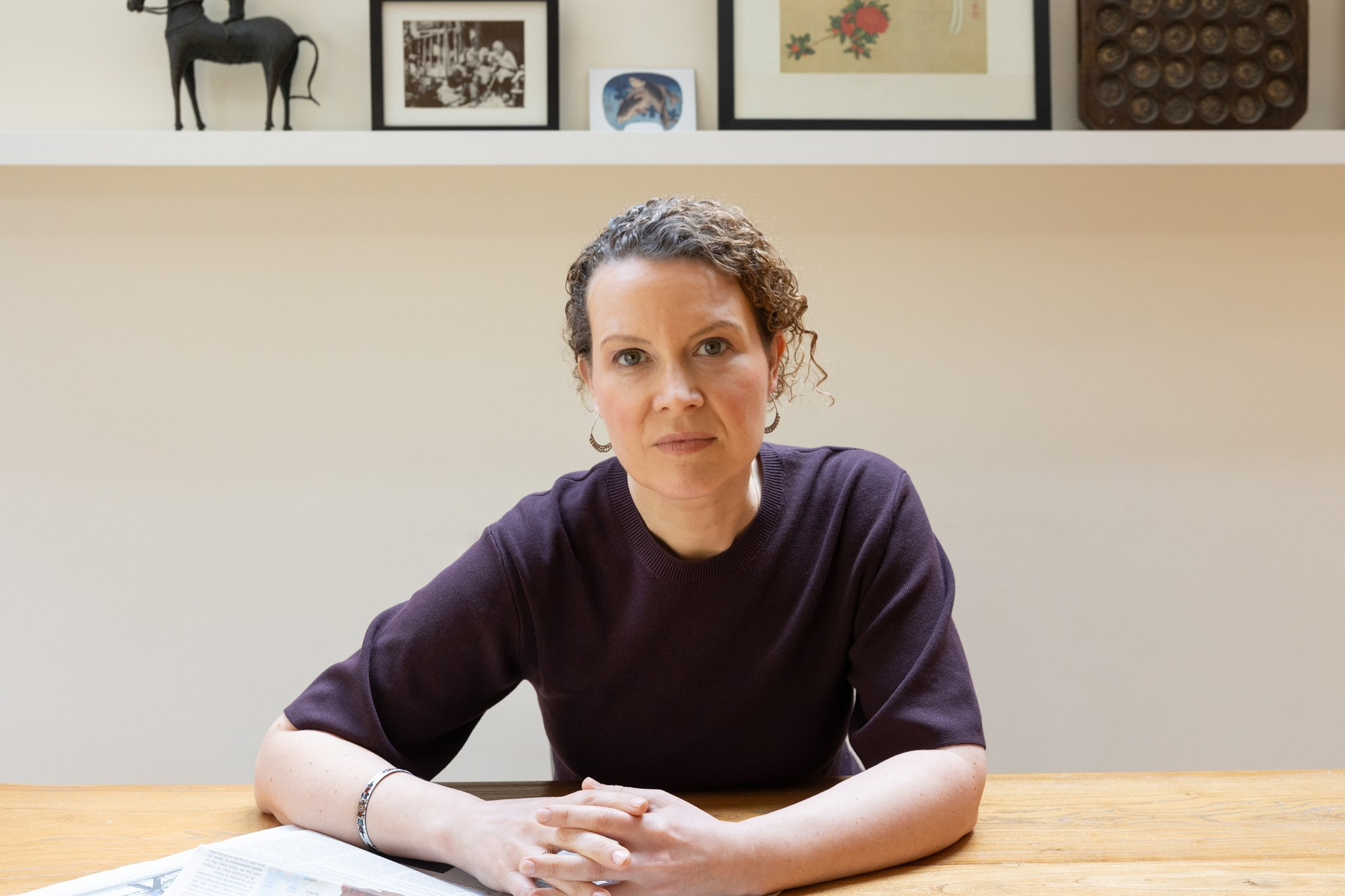
Celia Hatton on reporting from near and afar
The year 2008 was a transformative one for China. In the span of several months, the country eased its restrictions on foreign correspondents, hosted the Olympics, and struggled through a tragic earthquake that claimed approximately 70,000 lives.
Celia Hatton witnessed it all firsthand. As a fresh foreign correspondent from Canada, she traveled across the country, reporting from city centers, rural villages and even the frontlines of the Sichuan Earthquake.
Nearly two decades later, she’s now reporting from London; but continues to have a pulse on China. Now a veteran editor and correspondent for BBC News, Celia tells stories about China and the Asia Pacific on various platforms, spanning radio, broadcast, and documentary.
In an exclusive with NüVoices (edited and condensed for clarity), Celia reflects on her experience working as a foreign correspondent during the country’s “golden era”, building a successful career in global multimedia journalism, and carving out a space for herself as a woman in male-dominated newsrooms.
Did you always want to be a journalist?
I was a bit of an unusual teenager. I decided when I was 14 that I was going to become a foreign correspondent. I can remember having this moment of real clarity. I really love to travel, I love to write, and I really liked meeting new people. I like a lot of diversity. I always liked a bit of adrenaline in getting something done, like the drama of a deadline. I think a lot of 14-year-olds have ideas in their heads about what they want to do, but I just got this idea and I never changed my mind. I would think about other careers that I wanted and my second thought would always be, “Oh, but then I couldn't be a journalist, so therefore I can't do that job”.
I grew up in Canada, and it doesn't have a huge media industry. I had to solve the problem of how I knew where I wanted to go, but I didn't really know how to get there. I decided early on I would study politics at university because I thought that would be quite useful, then I got a job at a TV station in Toronto right after I graduated. I was really lucky. I was writing local news and I still wanted to go overseas. I was trying to figure out how to do that when I was introduced to a woman named Diana Bishop, who had worked as a correspondent in Beijing in the 1990s for a Canadian network. She really changed my life.She took what I wanted to do very seriously.
What made you move to China to report?
Her advice was for me to pick a country that was safe and cheap, but also ideally, where there was a growing news interest in that place. She had been in Beijing in the 90s, and so she sold me on going to China. I’d also studied China in university a little bit in my politics courses.
To be honest, when I first thought I'd go to China, I just thought maybe I'd go for a year and then I'd figure out what else to do. (But) Beijing won the 2008 Olympics. It set China on this huge course of development. It felt like I was there in this time when China was expanding, and it just made sense to stay.
It was just a really great time to stay, and I just kept getting opportunities. I got a job at a bureau really quickly, just working on their tape library, and then I got a job as a stringer. That was really useful because I learned on the job, made a lot of mistakes, and then I just kept moving up. Then, I got hired by CBS News to be their radio reporter and eventually got promoted to be the Asia Correspondent for them. I was with them for nine years before I was asked to join the BBC in Beijing. I just kept going up and then, at one point, it was time for me to leave China and luckily, I got a job with the BBC in London, where I've been ever since. I was always focused, to a large extent, on covering Asia, and I’m still keeping that focus because it's just always stayed interesting for me.
As you said, you were in China during a very transformative period. Do you have any standout stories to share?
It was such a special time, wasn't it? In my mind, it's divided into two halves, and I ended up being there for 15 years in total. There was the period leading up to the Olympic year, and then during the Olympic year, a few different things happened. It was a time of real opening.
The reporting rules changed, and you were allowed to interview anybody in China as long as you had their permission. It was just a golden era in which I think the government was slightly more permissive and allowed foreign correspondents to travel around the country and to ask questions. Then after the Olympics, we had the Sichuan earthquake, which had a really high death toll. It was really devastating. I ended up reporting on it for months.
What was that like?
It was really devastating to see. I remember there was one woman I was interviewing before we went on air. Then we did a live hit, and we were standing outside a school where children had been crushed inside, and all the parents were waiting for their children's bodies to be pulled out. Maybe every half hour, the rescue workers would bring out another stretcher with another body. This woman was standing, waiting for her daughter to be pulled out of the school. She knew her daughter was dead. While I was speaking live on television outside this school, she came and just started sobbing on my shoulder as I was reporting. I had my arm around her as I was talking and explaining what was going on. That moment was just so heartbreaking.
Afterwards, she left quickly, and I never got her name. I always just think about her and wonder how she is doing because I think we got her at a really vulnerable moment. I've never gone back and watched that bit of television. It was really raw, but it was just amazing. I don't know if she even knew that I was speaking live. It was a really painful, really emotional moment.
There were also very joyous moments, too. I was really lucky to be in China at a time when there was this explosion of development and movement where, for many people, the possibilities of what they could do in their lives really opened up. It was a real honour to witness that.
Now you report on China from London. How do you navigate reporting on a region from afar and what tips do you have to do that effectively?
You have to acknowledge that it's an adjustment, that there's a certain kind of reporting that you can only do when you’re physically in a place. But I think China is such a powerful country, and it has so much global influence that there are a lot of stories to be told from outside of China, as well as inside. In fact, some stories, I would argue, are better told from outside of China, so we can measure its influence.
I won’t lie, it's definitely a challenge in some ways to keep tabs on what's going on in China. I read a lot of blogs, social media accounts, and Chinese newspapers so that I don’t lose touch with the conversations inside of China. But I also think it is valuable to keep an eye on what’s going on outside, so a lot of the work I'm doing at the moment is geopolitics-focused.
I would say that I've never reported purely on China. I’ve focused on a lot of stories in Asia as well. In the past few years I've done stories on antiquities that were looted from Cambodia and have now ended up in museums in the UK. I also did a Panorama and World Service investigation on Chinese state spending. I looked at the patterns in Chinese state-backed money that is being used to buy up assets around the world, and that was a really difficult story.
I always start a story thinking, “I find this interesting, but I need to find the people who are going to help bring this story to life”. I’ve been really lucky in that I always end up finding these incredible people who tell these really colorful, detailed stories and lift the subject that I'm focusing on. My focus has spread a little bit beyond China since I'm not going inside the country to report, but I believe there is still a lot of value in looking at China from the outside.
Any stories you’re especially proud of?
When I start a story, I'm always looking for that little spark that makes me sit up and think, “Oh, I didn't know that before”. For example, I’d been working really hard on a lot of tough, serious stories, and I really wanted to switch my attention for a few months and do something that just felt different. I had a friend at a food programme who was looking for pitches related to food, and I just thought on a whim, “Instant noodles are a major thing in China especially, I wonder what the statistics are in terms of how many pot noodles are consumed every year in China and beyond.”
I looked up the statistics, and instant noodle consumption was actually declining in China pretty rapidly, while it was really increasing in the United States. I found that quite counterintuitive. I ended up getting the funding to do an hour-long documentary on instant noodle consumption called “The Eternal Life of the Instant Noodle.” It turns out, the answer to the mystery is that because the Chinese economy was doing quite well at the time, people were upgrading the food that they ate and choosing consciously to not eat as much processed food.
On the other hand, the United States actually has the world's largest prison population, and food budgets in prisons had been cut, so prisoners were bartering with instant noodles as a currency. We ended up going to China, Japan and the United States to tell this story which is essentially about food poverty. We found the most interesting people in each country to illustrate that story for us. Even though it was like it started from this one little fact that I uncovered, it ended up being just one of the most fun but also really informative stories I've ever done. I still look back on it and think, “Oh, that was actually just a great thing to do.”
It got a really big audience. I think all journalists just have to keep the faith that if they find something interesting, their audience will find it interesting. You just have to find the right vehicle to tell it.
Evidently, your work has covered a lot of topics, from international politics to everyday life in China. What is your process of coming up with story ideas? How do you decide which ones you would like to tell over others?
I think it's that spark. When I'm reading anything or speaking to anyone, I have a little radar in my head where I'm always looking out for that thing that will ignite that spark. It's that curiosity, that niggling thing that makes me think, “There’s something there” or, “That story hasn’t been told.” If I feel like there's a little mystery to be solved, then my audience might have that same connection.
Then, the next step is to do a bunch of research and speak to people and see if the story actually builds into something that might work. I'm lucky in that I work for an organization with lots of options for figuring out how best to tell each story. In a couple of weeks time, I'm going to be highlighting a Chinese researcher's work just because I think it might work best for an interview format. Sometimes I'll just write a text piece. I did a piece about preserving photographs that had been destroyed in the Japanese tsunami, and that was a text piece because you just have to be able to see the photographs for it to really work.
What do audiences (of the BBC and other global news outlets ) want to know about China? What do they resonate with and whattypes of stories typically do well?
The BBC is always on a mission to try to reach new audiences that they haven’t had before. There's always this drive to bring in younger audience members, and especially when working for the World Service, to think about our audiences around the globe. We take each story and think about how it might be received by a listener on the African continent versus in South America. I think there's that challenge when it comes to stories either being told from within China or being told about China.
For me, the challenge is to always fight against this concept that many Chinese people feel the same way, that there's a lack of diversity within China. It's actually the opposite. I try to highlight the diversity within China and also the humanity of many people in China, which might be different from how the government operates or feels. Those stories – about trends or conversations that are happening within China – tend to do well. Those are the stories that really surprise people.
There has been a lot of criticism about how Western media portrays China (namely, that it’s biased, reductive, or solely focused on the lens of national security). What are your thoughts aboutthis?
I think when we talk about geopolitics, it's difficult to get away from that description of China as one superpower. For example, last week, when Donald Trump went to visit China, we tend to use “China” as one entity. I think because the conversations within the Chinese government are so opaque, we don't know much about the internal debates that are going on inside the leadership, and the Communist Party presents itself as one unified body. Because of this, it's quite easy for any journalist, me included, to speak of China as if the government speaks with one voice. We talk about the diversity in American politics all the time because those conversations happen in the open. We have to remind ourselves that those conversations are happening in China as well, but they're just happening behind closed doors.
I think the challenge is to constantly remind ourselves that the Chinese people are incredibly diverse. The numbers of individual populations in China can be mind-boggling. It’s a challenge because it's difficult to pull out those individual strands of humanity and those individual conversations that are happening within China, while also, on a big scale, talking about geopolitics. They are two different kinds of stories.
We have many in our network curious about broadcast journalism. Can you share any advice on how to break into multimedia reporting as an aspiring journalist or one transitioning over from print? How do you write a broadcast pitch, and how does it differ from one for print?
The essence of all these stories are the same: Do you have something that sparks an interest in you that might elicit something in an audience, tell them something they didn't know before, or give them a different angle?
When it comes to broadcast pitches, you have to think about how you're going to tell that story with pictures: Where are you going to get the video to illustrate the story? What are going to be the strongest pictures that you're going to be able to use?
It's not the same as just taking a print story and wallpapering any old pictures behind it. It needs to be told with pictures in mind. A TV story that really sings is a one where you can tell the journalist has thought about the pictures right from the start. They're a key part of the pitch. Also, not every story works for every platform. Some stories that really sing on radio don't do so well in print because they're audio-rich, and it’s the same for broadcast.
We also have to think about how the story would be structured logistically: Are you going to be able to get a camera into the place where you want to carry out your filming? Cameras have shrunk a lot in size, so they're much smaller than when I first started out. Still, a camera attracts attention almost all of the time, so it can be a challenge. I also find that people’s behavior tends to change when they know they're being filmed. You have to be aware that asking someone to do an interview with a camera lens in their face can add an extra layer of anxiety for them.
Although women are represented more so now than before in newsrooms, few manage to rise up into leadership or senior roles. As someone who has successfully done so, can you share any advice for young women journalists who are emerging or mid-career?
Think about the stories that really drive you and that you get a lot of satisfaction out of telling. When you first start out, you're probably going to have to do a lot of grunt work. You might end up spending a lot of time working on things that might be drier.
One thing I've always done and still do is I've always had another project on the side that's just for me. Even if I am spending 80 per cent of my day working as a team player, just learning and absorbing as much as I can, during that extra 20 per cent of the time, I'm working on a project that is for me.
I found that over time, those personal projects are the ones that pay off because they're the ones that get attention, and they're the ones where I allow myself to stretch my skills, play a bit, and take some risks. I still give myself challenges to do, like the Panorama investigative project I did last year. It was really hard and it really stretched me, but I'm so glad I did it. You're not putting all your eggs in one basket. At your job, you're learning something, but it might not be filling you up creatively. Don't expect one position to give you everything. Give yourself something else on the side that you have more control over. Then you would not be putting so much pressure on one job to give you everything in your career.
What other advice do you have?
Constantly challenge yourself to find people to speak to and ask questions. Remember there's people out there who are going to support you. You can also take courses or do some reading to continually stretch yourself. That's also something that's within your control. That way, you're not just waiting for acceptance into an internship or a trainee scheme because that can be really challenging. Do one or two things that make you feel like you're in control and growing. That doesn't have to be up to anybody else. It can just be up to you and what you're interested in doing. It can be anything that gets you excited, and you're looking forward to working on it. That's the kind of thing that can really drive you and see you through those tough days.
Are you currently working on a project that is “something for yourself”?
Yeah, I've just pitched two big documentaries. Maybe I'm a bit geeky, but I think it's fun to research documentary pitches because they're always on things that I'm interested in. Sometimes I'll pitch a story, and it doesn't really work at that moment, but then I'll pitch it again in a year in a slightly different format, and it does get made. I often find that things work out in the end. You just need to hang on, keep them in your back pocket, and have faith that if you find something interesting, you can find a way for other people to be able to access it.
What about for succeeding in newsrooms and collaborative projects?
One thing I do think about is that I've been really lucky in my career and that I’ve built on relationships with colleagues that have really seen me through. Always be somebody that other people really want to work with. It doesn't mean you have to be a doormat, but I just like having fun at work with my colleagues. Sometimes when you're just starting out, you don't realise that the people you're working with might actually be people you stay in touch with far down the road. I think it's good to value the people that you're working with and realizing that you might be able to work with them for quite a long time makes everything a little bit less scary.
People kind of think that they're all alone in this, and they're not actually. It's a whole journalism community. Sometimes you meet somebody and then, five years later, they're on the same project that you are working on. You're not doing this on your own, even though it might feel that way.
About the writer
Suchita Thepkanjana is a co-editor at NüVoices. She is an incoming M.S. Journalism student at Columbia University and also works as an engagement coordinator at New Tide Media Network. She has previously covered politics, culture, and equality, among other topics, for The Momentum and The Beaver (the London School of Economics’ student newspaper), where she was also an editor. Find out more on her Instagram and LinkedIn.
About the editor
Jessie Lau is a London-based feminist writer and journalist. Born and raised in Hong Kong, she’s spent over a decade telling global stories about identity and power. Now, she’s executive editor at Translator, a magazine of translated journalism, and media lecturer at Kingston University. Her work has appeared in The Guardian, BBC, Los Angeles Review of Books, CNN, Times Literary Supplement, WIRED, The Economist and many more publications. Recently a judge for the Orwell Political Writing Prize, she also founded New Tide, Britain’s only East and Southeast Asian journalism network, and serves on the board of NüVoices.