
The Careful Curator
This review contains spoilers.
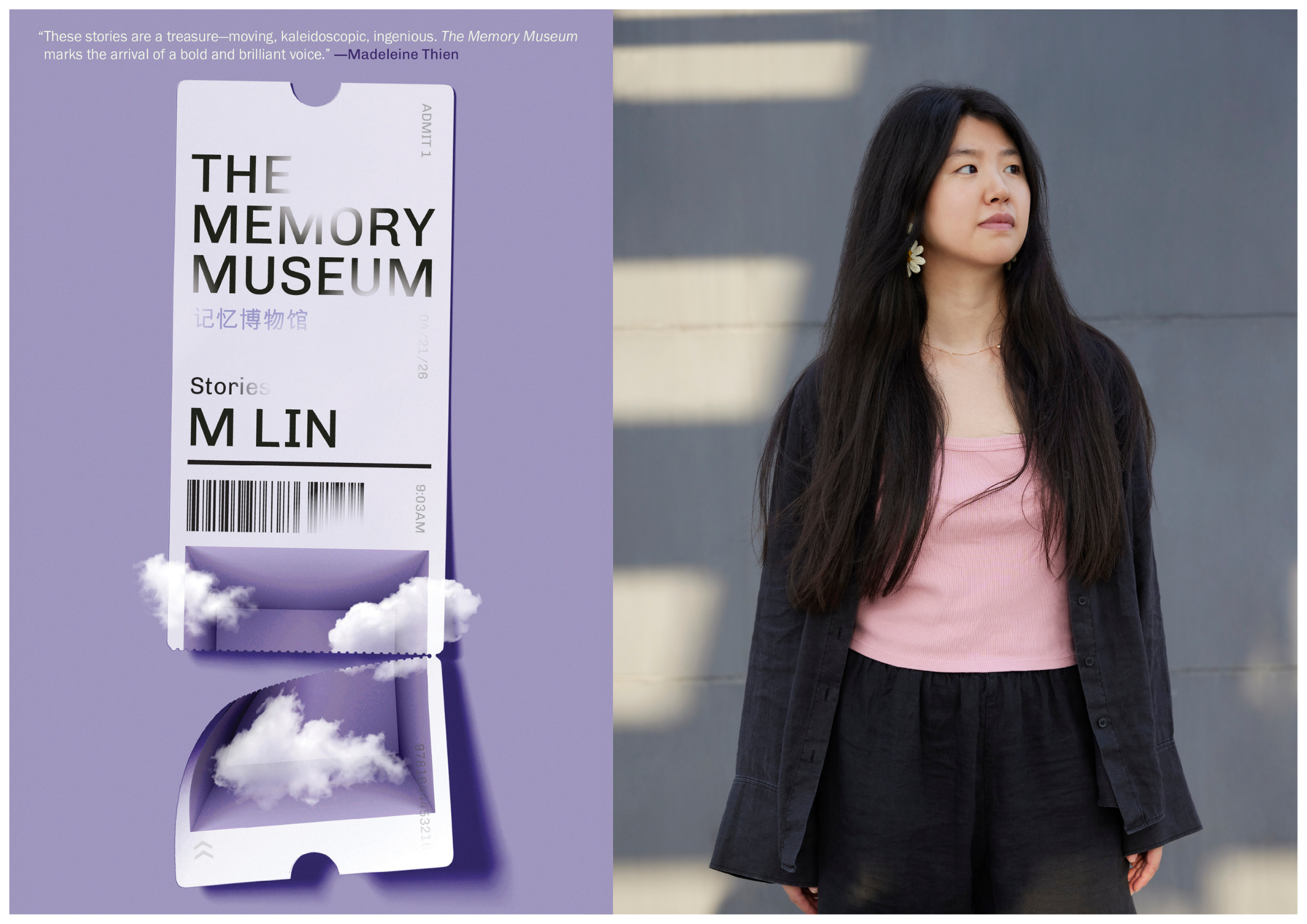
In her debut short story collection Memory Museum, Beijing-born writer M Lin presents an impressive range of portraits from contemporary China across eight stories – all written in English as her second language; Lin still prefers Mandarin in speech.
In ‘Magic, or Something Less Assuring,’ a marriage erodes under the pressure of unbridgeable political takes. In ‘Lucy,’ a woman who has built an academic career overseas considers keeping her brain tumour a secret from the parents she is flying home to see. In ‘You Won’t Read This in the News,’ the downtrodden, desperate, and left behind find fellowship even as they resort to petty crime. Lin writes people with a grace that is both generous and even-handed – everyone receives the same fair treatment under her observation. Lin follows a character’s own gaze inward through tumults of reflection, neither excusing nor condemning their thoughts and actions.
I have to note that the opening story, ‘Scenes from Childhood,’ sits somewhat uneasily within the rest of the collection. It lacks the measured assurance that distinguishes Lin’s stronger work and sets expectations that the subsequent stories go on to dramatically exceed.
A slight stiffness is born from the story’s post-apocalyptic world-building. Its premise is that a combination of technological viruses, biological pandemics, and extreme weather patterns have destroyed civilisation as we know it; those who can afford to go on living reserve places at a ‘fortified care facility.’ The speaker, Tiaotiao, is one of this lucky class, but finds herself unloved and alone, with nothing to live for but her memories of childhood. For me, this is an unnecessary framework that takes away from Lin’s otherwise nuanced reflections on family, class, and memory. The real story lies in those childhood memories: the friction Lin delineates between Tiaotiao’s comfortable Beijing lifestyle and the tough day-to-day of her uncle and cousins on their kiwi farm.
Tiaotiao frets over the loss of memory-storing structures (‘When the virus erased all cloud services in 2046, I lost all evidence that I had even existed’) and becomes obsessed with using ‘the neurological writing device from the facility’ to record and relive her early memories. But writers have been driven by a compulsion to commemorate – things, people, events – long before the cloud came into being. Lin references Shakespeare’s Sonnet 30 at one point – Shakespeare famously obsessed over immortalising the memory of his lover through his sonnets, and he did not need to situate this angst in a dystopian world in order to communicate the human urge to write things down. Lin does go on to express this urge through a more interesting, embodied lens: ‘Without documentation, my life belonged solely to myself again,’ Tiaotiao reflects, ‘and my memories were alive within me, in a state of ongoing metamorphosis.’
Meanwhile, ‘You Won’t Read This in the News’ is Lin’s writing at its most attentive and assured. It follows two men, Qiang and Wen, who have both been scammed into applying for a non-existent hotel security job. Conned out of the last of their money and wrung dry of any hope of finding work in the big city, they take a bus to Kunshan. The story opens with a description of the cramped bus, men in the back all ‘alike in their white cotton tank tops, lean and malnourished, their hands young but rough from carrying bricks, mixing concrete, scaling steel panels and poles with no safety net underneath.’
In Kunshan, Qiang and Wen begin robbing cars parked along the quiet streets. It soon becomes apparent that their desperation is far from unusual, as they encounter burglar Song An and teenage mother-to-be Shanshan. They act unforgivably by each other, then give each other the gift of hope by showing that, even at their lowest, people do still care, feel, and carry good around inside them.
The story balances moments of comedy and tragic reality in tension, and the contrast is especially effective when Lin weaves between consciousnesses. Take the moment when Qiang and Wen apprehend and rob nineteen-year-old robber Song An, searching his pockets: ‘This really tickles, the burglar thinks, and even with a knife at his neck, he can’t seem to suppress his giggles.’
The narrative then swings into the mind of the older man, Qiang – standing with the knife in hand, thoughts of his wife and unborn son pushing in on that moment of violence. ‘When his son reaches nineteen, Qiang will seldom get as close to him as he does to Song An in this moment, the boy’s body locked in his arms, their faces nearly pressing into each other, the horror in the boy’s eyes so transparent up close.’ Lin demonstrates real agility by resituating the story in different contexts. Acts we might abhor are expressed within an epidemic of hopelessness: characters recognise in each other the same weary struggle against a world that does not want to give them a chance.
There is a vital, questioning instinct in Lin’s writing. In ‘Shangri-La,’ a Chinese accountant living and working in Pittsburgh wanders into the Shangri-La Magic Massage Parlour and is magnetised by her masseur, a young man from Shaanxi province. The protagonist’s life consists of detached, uninteresting people who come round to talk ‘Crypto, stocks, promotions, bonuses, corporate packages, […] skiing and surfing’. But, watching the masseur knead her calves, the accountant is struck with naive astonishment at the division between their worlds. Both are Chinese immigrants, both made the same journey across the Pacific – this simple fact is insistent, urgent.
‘In their own country, he would have been invisible to her. But in America, in Pittsburgh, in the neighbourhood where they both worked, the accountant couldn’t look away from him. What had she done to sit at one end of the sofa and the masseur at the other?’
Detachment characterises the accountant’s world: characters are nameless – the only named thing in the story is the husband’s George Foreman barbecue. But the accountant and the masseur soon find connection, sharing their bodies, the food of their hometowns, the ‘syrupy’ songs by the popstar who, though likewise unnamed, is undoubtedly Jay Chow.
This connection between two nameless, lonely people brings to mind questions Lin articulates in ‘Lucy,’ a story where the looming presence of death confronts us with our duties to those we share life with. These questions – ‘What do we owe each other? What is the right way to love? The right way to die?’ – are the true studies encased in every one of Memory Museum’s stories. Lin does not resolve them. She leaves them suspended, like her characters themselves: searching, uncertain, and unmistakably alive.
Memory Museum can be purchased online on Bookshop.org and Amazon.
About the writer
Heather Skye Irvine is a writer interested in literature as material for cross-cultural understanding between people and in the natural world. She has a poem in the new anthology Elemental: Water (Worple Press, 2026), which she’s inordinately excited about. She was born and raised in Hong Kong and aims to emulate the city’s collisions of East and West in her writing. Find out more on her website.
About the editor
Lijia Zhang is a factory-worker-turned writer, social commentator and public speaker. Her articles have appeared in The Guardian, The South China Morning Post, Newsweek, and The New York Times. She is the author of the critically acclaimed memoir “Socialism Is Great!” and her debut novel Lotus follows a prostitute in China. Lijia has lectured at many conferences, institutions and universities around the world. She is a regular speaker on the BBC, Sky TV, CNN and NPR.
Photo credit: Guo Guo