
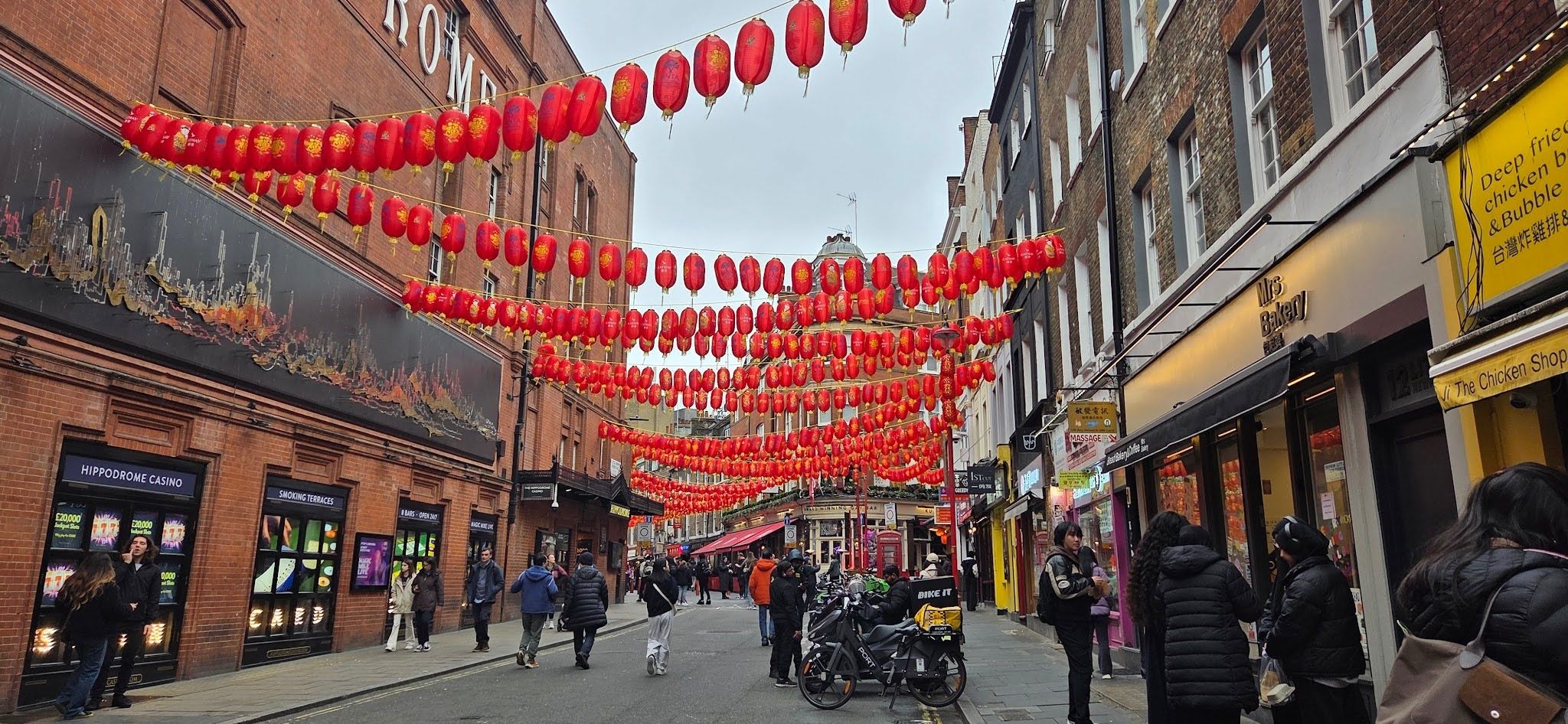
Space beyond the red gate
This essay is an exclusive excerpt from Golden, an inaugural anthology dedicated to the ESEA community in the UK. Buy a copy here.
London’s Chinatown was not always in Soho. The first one was in Limehouse, where Chinese seamen settled in the 19th century, but it was severely destroyed during the war.
After the 1950s, a new wave of Chinese migrants arrived: agricultural labourers from the New Territories of Hong Kong. Facing rural unemployment at home, they travelled to Britain with little English and settled around Gerrard Street for low rents. Despite its central location, the area had a seedy reputation - crime, dilapidated neighbourhood, and a prominent sex industry.
As Chinese businesses gradually flourished, Westminster Council officially designated the area, bordered by Shaftesbury Avenue, Rupert Street and Leicester Square, as an official Chinatown in 1985. Nine streets were pedestrianised, bilingual signs installed, and the now-iconic stone lions and ceremonial gates erected. Yet, celebration did not bring better cleanliness or safety. Real improvements only came with the 2003 Chinatown Action Plan.
Today, Chinatown’s urban planning is controlled by the council and the property investor. However, long before it was a red-lantern tourist magnet, the Chinese community had already been calling it Chinatown.
Here are the stories of the Chinese and East Asian community members who continue to define this space - beyond the official label.
Space for family memory
For young first and second-generation immigrants, Chinatown is entwined with family memories and food.
London-based Malaysian-born chef Mandy Yin, who moved to the UK at 11, recalls visiting Chinatown on Christmas evenings for dinner around the West End, and sharing dim sum and roast duck with visiting relatives and friends. “Having an official Chinatown is a blessing. It means that we have a meeting point at the city centre,” she said.
Chinatown has been a symbolic anchor for her. “It has been a constant rock in my London life. Whenever I come to Chinatown, I feel a sense of safety and belonging, of not being the other.”
But Chinatown itself has never been constant. Rapid commercialisation has reshaped the area, replacing cultural landmarks like the pagoda at Newport Place. For many like Anh, a Chinese-Vietnamese community artist raised in London, the simple, unifying phrase was: “Meet me at the pagoda.”
She described the pagoda as a “starting point” - both for her and her friends’ Soho adventures and for finding her way when she got lost with her family. The pagoda is now gone, as is the now-defunct charity China Exchange. Anh says, “I understand why the area heavily relies on tourists, but now that sense of a community doesn’t feel that strong? I feel Chinatown’s spirit has dimmed a bit.”
Like Mandy, Chinatown helped shape Anh’s cultural identity. She used to feel excited visiting Chinatown because she could play arcade games and be “silly teenagers” in Trocadero. She could buy Cantopop cassette tapes, listen to them on the car ride home, write out the Cantonese lyrics and sing along. She could learn dialect or Cantonese, retaining the part of herself and communicating with family.
Read in full here
About the writer
Angel Sun is a freelance journalist passionate about human-interest and long-form feature writing in both Chinese and English. Her work, mainly exploring East Asian diaspora and gender issues, has appeared in Initium Media. She also writes film reviews for The Indiependent and news articles for British local newspapers like Hackney Gazette. She is deputy social editor at NüVoices. View her portfolio and LinkedIn as a fresh journalist here.