BY ANGEL SUN
*This feature was originally published in Initium Media on 26 July 2025. It has been edited and translated from Chinese into English by the author. Illustration: Angel Sun
Every day, Catherine’s routine is packed and mundane. After getting up at 7am, she makes breakfast for her children and takes them to school. She makes breakfast for her husband at 9am, and it is then her turn to eat. At 10am, she tidies the kitchen, plans the dinner, thaws the meat, and cleans the house. After lunch, she pre-cooks the dinner and sets the rice cooker’s timer. She picks up her kids from school at 4pm, and has dinner at 7pm. After cleaning the kitchen, her day is over. Then, it all begins again.
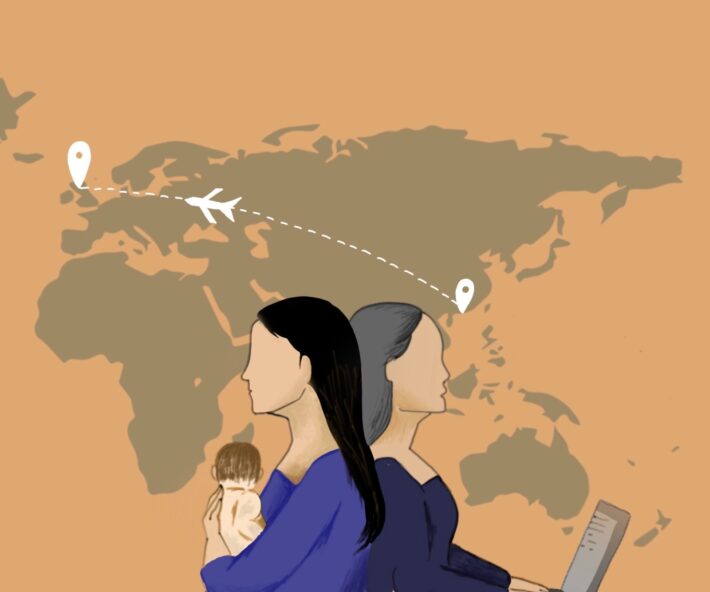
Catherine is one of over 150,000 Hongkongers who have moved to the United Kingdom in recent years through the government’s British National (Overseas) visa programme. In this process of migration, many migrant mums gave up their careers and became full-time housewives. Like Catherine, many report feeling lost and are struggling with self-worth. In this strange land, what does motherhood mean to them?
Less capable
In 2021, Catherine moved to the UK with her husband and eight-year-old twins. Once a human resources officer, she used to be a typical working mum in Hong Kong—working overtime every day, and employing a foreign domestic helper to take care of household chores and childcare.
She described being a full-time housewife as “a choice without a choosing.” Although BN(O) migrants are eligible for 15 hours of free childcare per week, the waiting time for such services can be up to three years due to shortages in funding. Also, working parents have to pay for additional hours if they cannot pick up their children between 3pm and 4pm.
Catherine cannot afford the childcare cost, but she did want to try being a full-time stay-at-home mum. “My kids always feel so proud when I pick them up in person with snacks. It seems that my fantasy of being a full-time mum has come true,” she told NüVoices. However, her smile faded when she reflected on her identity outside of motherhood. “I feel less capable than before, or sometimes out of touch with the world.”
For Catherine, professional skills that once came easily have since become difficult. Recently, she tried to help a friend create a PowerPoint slide, but forgot how to attach a link. She had to ask her husband for help, step by step. The frustration brought tears to her eyes.
“I used to be an Excel and PowerPoint master. I worked so efficiently and accurately. How can other mums try out new recipes and take interest classes? I can’t do it. I don’t have time. I don’t even have the chance to turn on my computer,” she said.“It is just a transitional period. I can pick up different skills one day.”
At home, but never at rest
Like Catherine, Tina moved to the UK in 2021 with her family of four. She used to work in marketing, and her household duties were taken care of by a foreign domestic helper and her parents. After moving to the UK and struggling to find a job that could accommodate their childcare needs, she decided to stop working.
When she first arrived, she needed to look after her one-year-old son 24/7. She felt that she had already lost all personal space, and winter depression as well as the COVID-19 pandemic made everything worse. Even the church, the only place Tina could socialise, was closed. For most of the day, she was “trapped” in the house with only her son, while her husband woked and her daughter attended school.
As her mental health deteriorated, the gap between her and her family also widened. When she attempted to carve out some personal time for herself, her husband replied: “You stay at home every day. Don’t you already have plenty of me-time?”
After months of argument and discussion, the couple reached an agreement. Whenever the family has a day out, Tina can spend an hour in the supermarket just by herself. For her, it’s the only time she feels truly at rest.
Now both of her children are of school age. Having met other mums and learnt to schedule her day, she has more free time now. Looking back on the first two years in the UK, she says: “At that time, I always thought I had adapted to the new life here, but I was not. I just did not even have space to feel my emotions.”
Becoming a mum again
Another new migrant calls herself “Snail Mum” as a self-reminder to live slowly. The name is in many ways a stark contrast to what her colleagues used to call her, which was “T. Rex” (short for the dinosaur Tyrannosaurus rex).
Snail Mum has a 14-year-old son and a four-year-old daughter. Unlike Catherine and Tina, she did not choose to be a full-time mum out of financial concerns. When she left Hong Kong, she was determined to be a mum again.
In Hong Kong, she was a senior teacher at a private school, working from 6pm to midnight every day. She even prepared notes and summarised her friends’ opinions before the interview.
Life was good–but this all changed when her children entered Hong Kong’s notoriously high-pressure school system and began to struggle.
Once outgoing and polite, her son abruptly changed after going to school. He never smiled again and became a “say no” boy who refused to try anything.
Hong Kong is a pressure cooker where children’s self-worth is defined by their academic performance. Despite being an experienced teacher, Snail Mum did not know how to help her son, and out of frustration call her her son “stupid” and demand that he sit still while studying.
She soon realised that this strict parenting style did not help her son. Therefore, she decided to make a change when she migrated to the UK in 2021.
After settling in the UK, her son became free of the intense pressure he was under in Hong Kong. He began playing football and running at school, which he never had the chance to do previously. He told his mum calmly: “Trust me. I will go skipping and running first. I can stay focused after exercising.”
The new environment freed her and her son from Hong Kong’s social rules. Now, she reflects on her change in parenting mentality: “In Hong Kong, I was completely lost. There, everyone ‘teaches’ you to be a mum. Family, friends, and strangers just blame the mum when the child slightly misbehaves. When people complimented my son for being ‘polite,’ it just pressured him and me to follow the social rules. The pressure, given by the world and myself, was inescapable.”
Unlike Catherine, Snail Mum does not care whether she can return to the workplace. “The school can easily find someone to replace me as a member of staff,” she said. “However, my children need me. Their happiness is my priority.”
Self discovery
While Tina always enjoyed her former marketing job, Catherine and Snail Mum felt they had been pushed to work full-time by Hong Kong’s societal expectations. Catherine says: “I never stopped working after graduation. The whole society forces me to move forward and never allows me to stop. It is a valuable opportunity for me to stop and actually stay with my family.”
Between 2019 and 2021, social science professor Dr. Lok Sun Ngan at the Hang Seng University of Hong Kong interviewed 21 Hong Kong migrant mums in the UK, United States, Canada, and Australia. She found that although many of them felt sad about losing personal space and financial independence, they were generally pleased about their improved family life. They felt a greater sense of ownership of their families, which compensated for their losses in career progression.
Migration allowed them to take a break and re-explore motherhood. When asked about post-migration life, they always talk about the children. When asked about their “self,” they pause and smile, with a shade of shyness.
Now, Catherine wants to be a nail artist. It is a less respected job in Hong Kong, so she never talked about it, and only decided to do so after moving to the UK. Tina started to bake cakes and is now running an online bakery. The matcha strawberry cake and yuzu mousse cake have given her invaluable personal space, she says. Out of all of them, Snail Mum is the most excited when talking about her newfound “personal life.” She told NüVoices: “I am now a fan of (Hong Kong boy band) Mirror!”
Mirror, consisting of 12 members, is one of the most popular Hong Kong boy bands. While seeing them perform during their UK tour last March, Snail Mum met other “fan-mums” and built a community. They not only run an Instagram fan page and hang out together, but also organise events like screenings of the Hong Kong film The Last Dance. Last year, their screenings attracted over a hundred attendees, including a mum from Hong Kong who told them that the screening allowed her to make friends here for the first time.
“I once hosted workshops for hundreds of teachers, and such so-called achievement was gone when it was over. Now, someone told me I actually impacted their life,” Snail mum told NuVoices.“It means a lot.”
Grateful for a reset
As they take on a new life in the UK, many Hong Kong mums are finally taking a pause. They’re reflecting on their life as a mum, employee, and a person. A few years later, they may enter another life stage. How will they look back, and will they regret becoming a full-time mum?
“I don’t have the answer yet,” Catherine said. “I’m still exploring my new identity as a full-time mum, but I’m grateful for the chance to start over.”
*All names have been changed due to privacy concerns
About the author
Angel Sun is a freelance journalist passionate about human-interest and long-form feature writing in both Chinese and English. Her work, mainly exploring East Asian diaspora and gender issues, has appeared in Initium Media. She also writes film reviews for The Indiependent and news articles for British local newspapers like Hackney Gazette. View her portfolio and LinkedIn as a fresh journalist here.
About the editor
Sherry Chan is the chief editor at Initium Media. Her commentaries on international and Hong Kong politics have been published in news outlets like Ming Pao, and she is the author of Jasmine Blossoms: Revolution and the Road to Democracy in the Middle East.