BY KELLY YU
Overseas Chinese feminists in London are calling on the Beijing government to strengthen protections against digital violence and the sexual exploitation of women, in the wake of a massive online sex scandal that recently rocked the nation.
Sexually explicit photos of many women that were covertly taken without their consent were found last month to have been shared in a sprawling underground forum called “MaskPark tree hole” on Telegram, an encrypted messaging app. The forum shared voyeuristic content across at least 20 sub-groups, with the largest reportedly reaching 900,000 members.
According to local news reports, the circulated content included private photos shared by ex-boyfriends and current partners, as well as footage of female family members including wives, mothers, and daughters. Videos secretly recorded with pinhole cameras in public spaces and hidden cameras disguised as everyday items were also being sold through the group. Footage was reportedly filmed in a variety of locations including ultrasound rooms, public restrooms, railway stations and shopping malls.
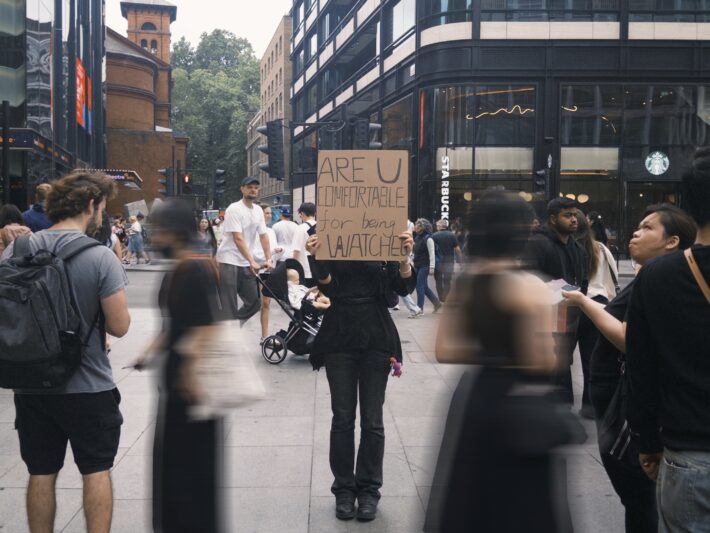
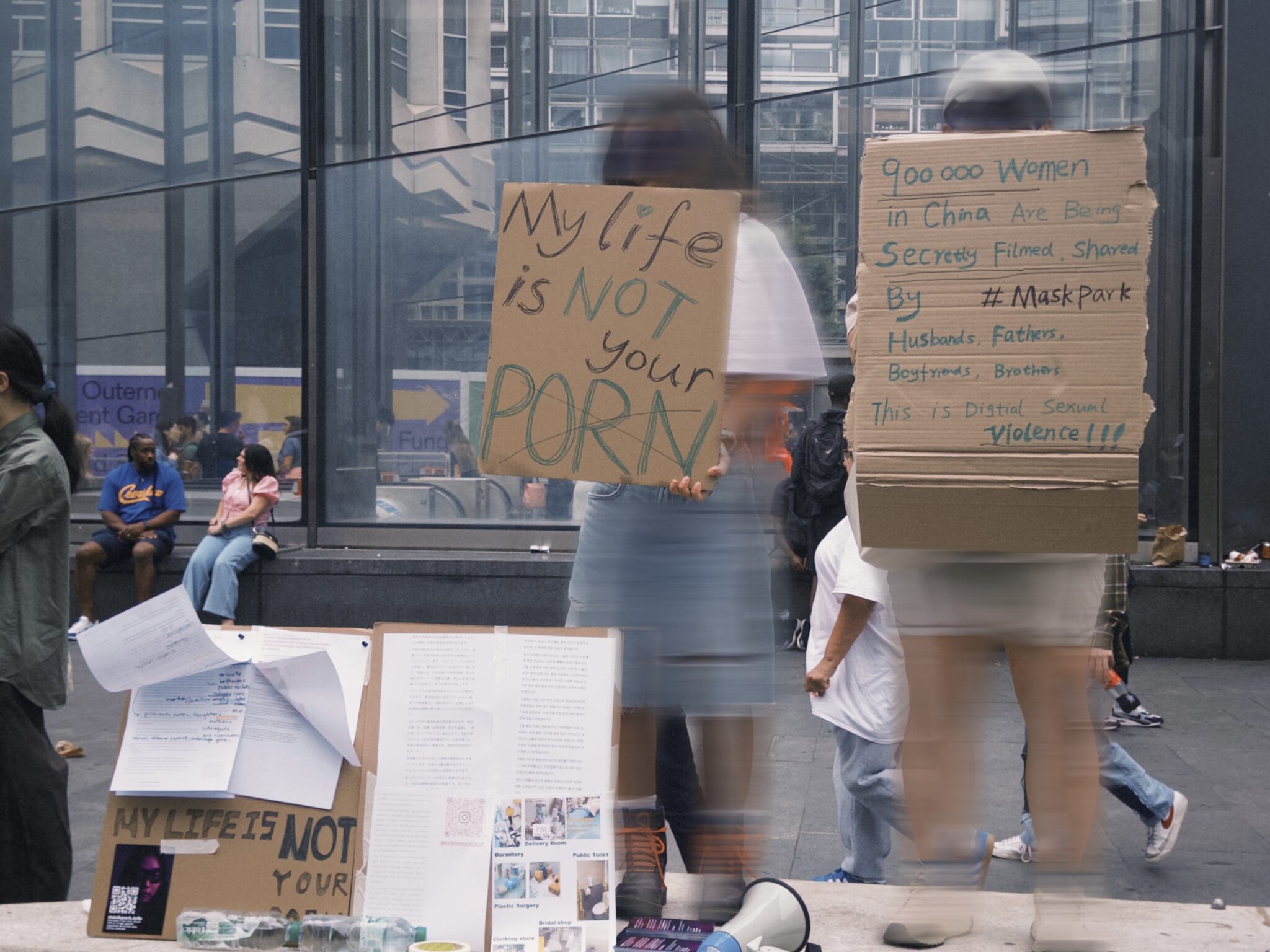
On August 16, about 25 protesters rallied outside London’s Tottenham Court Road Station to stand against such digital violence. Demonstrators wore purple masks, distributed informational flyers, and invited passersby to show solidarity through an online emoji campaign.
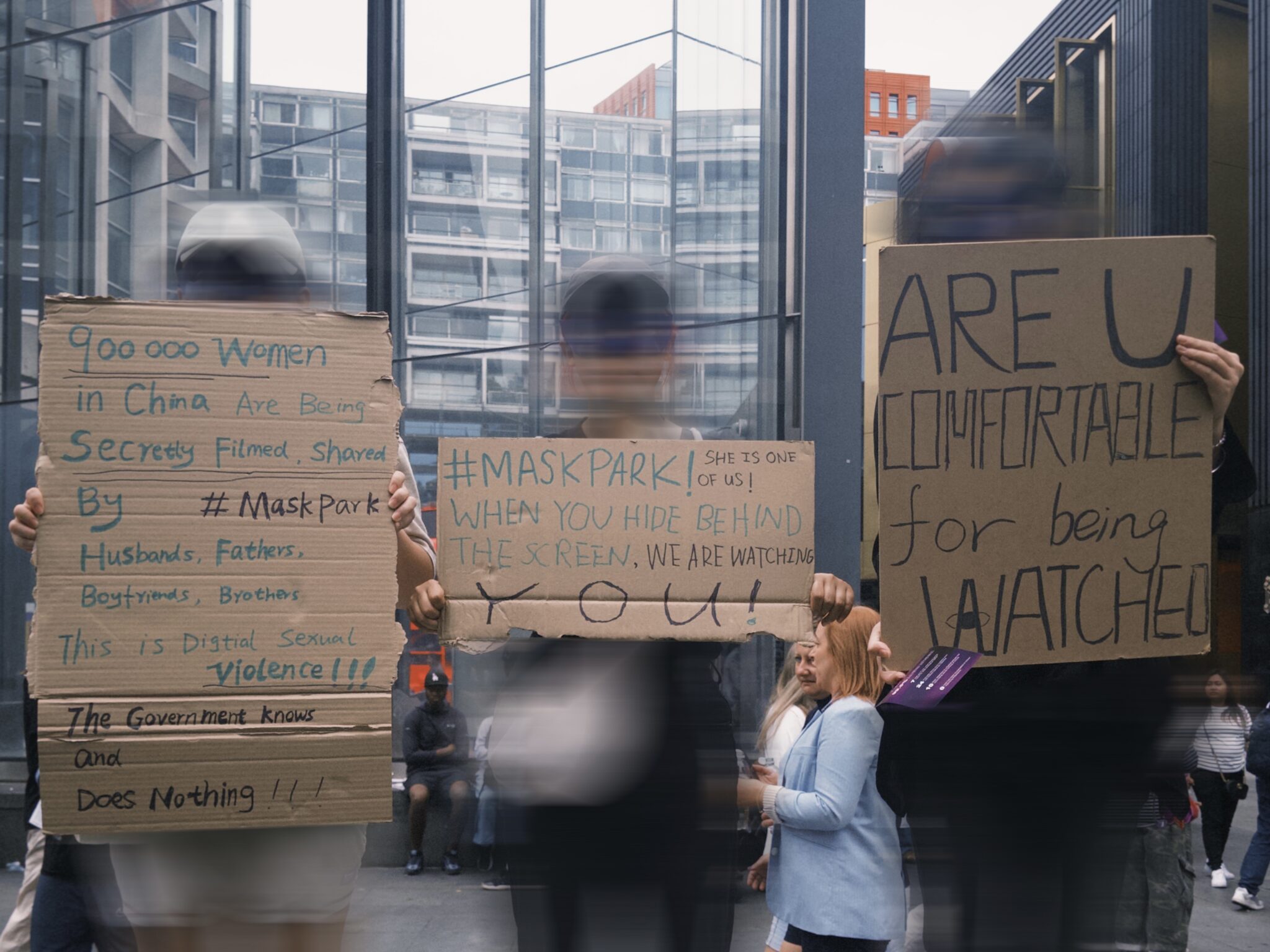
Jing*, an overseas Chinese organiser, told NüVoices that protesters are calling on the government and relevant organisations to investigate the individuals behind the MaskPark Telegram group.
Currently, the penalty for filming and photographing an individual without their consent in China is a 500 yuan (£53) fine and up to 10 days detention—which Jing believes is insufficient.
“China must strengthen its laws to impose heavier penalties for voyeurism, sexual assault, rape, and all related offences—not just a maximum of 10 days in detention,” she said.
Jing says the fear sparked by the MaskPark scandal has spilled over to Chinese women living overseas. She’s concerned about the safety of her female family members in China.
“Women share a common experience of safety and bodily autonomy. In my distant homeland, countless women—and every one of them lives in me. This is not about borders. They are us. We are them. I am you,” she said.
Victims of the MaskPark scandal have also shared their experiences on social media. When Ding* received a message from a stranger claiming to possess her private photos, she initially dismissed it as harassment. But a nightmare soon unfolded as she discovered her intimate images may have been leaked to over 100,000 members of the MaskPark group, which were reportedly mostly Chinese-speaking men.
After clicking the link the stranger sent, Ding was horrified to find her private photos and videos published on Telegram by her ex-boyfriend, who had recorded their intimate moments without her consent.
“Every woman could be a victim,” Ding wrote on her Weibo page (a Chinese digital platform). “What I found is only one small channel, but I’m sure there are many more like it on Telegram.”
Her post has attracted 44,000 likes and more than 20,000 reposts on Weibo since mid-July. Ding told Chinese media outlet Fengmian News that she reported the case to the Cyberspace Administration of China. She also reportedly contacted the Internet Crime Complaint Centre in the United States, where her ex currently lives. NüVoices has reached out to Ding for comment.
Gathering evidence against the MaskPark perpetrators is difficult, as Telegram’s security settings prevent users from saving or screenshotting chat records and media, according to feminist advocates.
Feminists trying to raise awareness face additional obstacles within China’s internet ecosystem. When activist Fagaso* posted about MaskPark on Chinese social media platforms, her content was quickly removed by censors, she told NüVoices.
“I felt like there was an invisible net tightening around us—like someone was trying to grip our necks, bind our hands, and cover our mouths,” Fagaso says.
To call for international action and stronger digital protections for women in China, Fagaso started a petition on Change.Org, which has attracted more than 1,800 signatures since July 30.
Fagaso hopes the petition will bring meaningful changes and ultimately hold the perpetrators accountable.
“They should be arrested, investigated, and punished according to the law. There should be no protection for abusers—and if there are those who protect them, that system needs to be exposed too,” she said.
Ginger*, a college graduate in her 20s working in Shenzhen, signed the petition after learning about the MaskPark incident through Xiaohongshu, a Chinese social media platform.
She accessed the Telegram groups out of curiosity in late July, and found explicit images featuring around a dozen women in public toilets. The impact on her daily life was immediate: “The next morning, while using the restroom at my office, I found myself instinctively wondering if there were cameras near the rubbish bin. When I saw all of this, I realised I could no longer remain a bystander like I did a few years ago with the South Korean Nth Room case,” she told NüVoices, referring to the scandal in South Korea between 2018 and 2020 where criminals used Telegram to blackmail women into creating sexual videos, and then shared them without their consent.
The main MaskPark group has since been shut down, though smaller offshoots remain active on Telegram, NüVoices found. Some sub-groups continue to share explicit content, including one that had 355 members. A quick search also revealed that one paid subscription channel with more than 16,000 monthly users is still operating. It claims to distribute new illicit videos daily. NüVoices has reached out to Telegram for comment.
A spokesperson from Telegram told NüVoices that nonconsensual porn is strictly prohibited under its terms of service and its moderators are monitoring public parts of the app with AI assistance.
“Moderators continue to monitor the platform proactively and accept user reports—so that if groups like MaskPark Tree Hole ever resurface, they are immediately removed,” the spokesperson said.
Despite the trauma, Ding hopes her journey will encourage other victims to speak up. “If other girls have experienced the same situation as me, please don’t carry any psychological burden. Don’t be afraid,” she wrote on Weibo.
*Names have been changed to ensure the safety of sources
About the author
Kelly is a Hong Kong-based multimedia journalist exploring the intersection of gender, culture, and technology. Her work focuses on amplifying women’s and underrepresented voices across China and Hong Kong. Her bylines appear in Earth.Org, Radio Television Hong Kong and the South China Morning Post.