BY TAPPY LUNG
*Editor’s note: The following story was a runner-up in our first ever annual NüStories personal essay contest. This year’s theme was Chinese identity – read more here.
I’m eight weeks into my travels throughout South America. It’s my first time on the continent, and I’ve never been more aware of my Chineseness.
I’ve had people stop me in the street to guess where I’m from. “China?” they ask. Some assume outright; they put their hands together and bow towards me. People yell, “Ni hao,” from passing buses.
Even after I explain that I am American—born and raised in New York—people misunderstand my connection to China. Over lunch with a new Brazilian friend, she noticed I didn’t add salt to my salad. “Chinese people eat so healthy,” she said. “I think that’s why China’s life expectancy rate is so high.” Once, after an Uber ride, my driver parked his motorbike to show me TikTok videos of electric cars made in China. “Good,” he said, with a thumbs-up.
In my first weeks in Peru and Brazil, I was taken aback by how openly people pointed out my Chineseness. Growing up in the United States and traveling through Europe and Asia, I had never experienced interactions like these with such frequency.
I know it’s futile to correct every stranger on the street. I ignore the aggressive questioners and reciprocate bows to those attempting to respect what they think is my culture. I patiently explain that my diet, especially now as a budget backpacker, is hardly representative of 1.4 billion people in China. And that, while I happen to know a bit about Chinese electric vehicles, it’s because I spent years studying China’s economy as an analyst in Washington, D.C.—not because I am ethnically “Chinese.”
It’s jarring to be reduced to a singularized “Chinese” identity—complete with all its stereotypes and assumptions—when I’ve spent my whole life trying to untangle the threads of my Chineseness.
I took a DNA test once and it confirmed that I am genetically 100 per cent from Southern China. Yet my genes explain so little about how I understand, express, and experience my Chineseness. I grew up speaking Cantonese and English. I have never been to Mainland China. My mom’s family has lived in the Malay Peninsula for generations, blending the traditions of Hokkien, Teochew, Hakka, and Cantonese settlers into our household and kitchen. My dad grew up speaking Hakka in the New Territories of Hong Kong. Even within my own household, my parents have vastly different ideas of what it means to be “Chinese.”
Many nuances are lost in the word “Chinese.” The label oversimplifies the history and diversity of over a billion people and their billions of ancestors. As the usage of Mandarin overtakes other dialects in China, and China exports a standardized version of “Chinese” culture to the world, the term increasingly becomes tethered to a geopolitical entity rather than a historical connection to land. When living in Singapore, I was shocked to learn that regardless of linguistic heritage, if one’s ancestors came from China, they are designated as “Chinese” on their Singaporean ID and required to learn Mandarin in school. Policies like these reinforce the importance of amplifying the diversity of people’s experiences with Chineseness.
The label “Chinese” overshadows my lifelong effort to understand my own identity—the ways I have blended my “American-ness” with the traditions, languages, and perspectives of my parents and ancestors. And this is common. “Chinese” people frequently distinguish themselves by nationality, language, immigration history, regional identity, indigenous status, and even dynastic affiliation.
Yet, despite these differences, my travels in South America have reinforced that people will first and foremost perceive me as a Chinese woman. No matter the contradictions and nuances I hold within this categorization, my Chineseness will continue to shape how I interact with the world.
People read my face and see my ancestors and a country I have never been to, despite the vastly different life I lead from both my ancestors and most people in China. I am the first in my family to be born in the United States, the first to dream in English, the first to graduate from university, and the first to have the privilege and freedom to travel for something as foreign as “finding myself in my twenties.”
My travels have been a crash course in how the world interacts with my Chineseness. In turn, as one of the few “Chinese” backpackers in this part of the world, I have found it a valuable opportunity to expand others’ perceptions of what it means to be “Chinese.” With each interaction, I shape how the next person will experience Chineseness here.
I say:
I am “Chinese” in the sense that my ancestors came from what is now modern-day China. That my parents raised me with a culture shaped by the China of long ago, as it intertwined with the colonial histories and local traditions of Hong Kong and Malaysia.
I am “Chinese” in the sense that my first language is Cantonese and that my comfort foods are congee and New York pizza. I am “Chinese” in the joy I feel celebrating Chinese New Year and the familiarity I feel when I walk through a Chinatown anywhere in the world.
I am “Chinese” in the spirit of the Cantonese pioneers who first left China, like my ancestors who moved to Southeast Asia, like those who built the railroads and Chinatowns of the United States. I am “Chinese” in the way that, on the rare occasion I see another “Chinese”-presenting person in South America, we share a knowing glance. You and me—we share an understanding of what it means to be “Chinese” here.
As I travel through the cities, small towns, and mountains of South America, I carry only what fits in my 16.7-pound backpack—my clothes, hiking gear, toiletries, passport, and the weight of moving through this world with a proud, puzzling, paradoxical Chineseness.
About the author
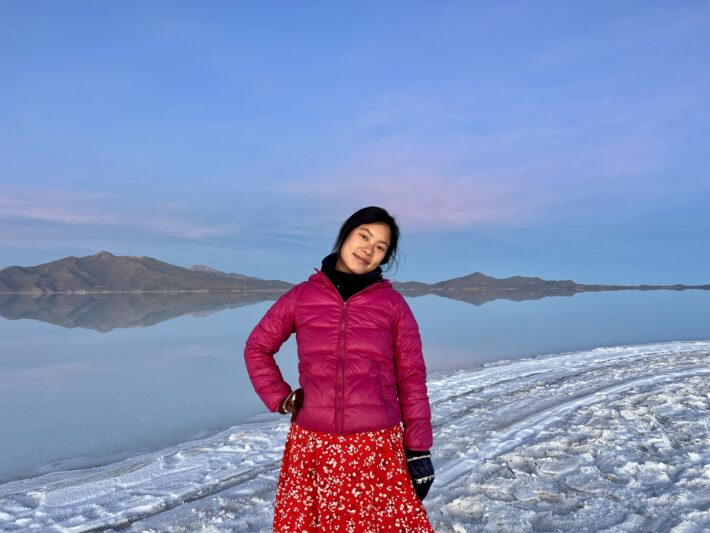
Tappy Lung is a policy researcher specializing in identity politics, international development, and democratic governance. She holds a Bachelor of Arts in International Affairs and Political Communication from The George Washington University and is pursuing a Master’s in Public Policy at the Harvard Kennedy School. Photo: Tappy Lung.