
BY RICHARD C.
This review is part of a series of reflections on Chinese films presented by the 2025 Beijing International Film Festival.
Days before heading to the theatre to watch the movie, I had only watched the trailer of Beyond the Skies (云霄之上) and read a brief summary about the movie, so I knew, at least I thought, what to expect.
I am a fan of doing some basic research prior to watching something new, but not too much that would spoil my overall enjoyment and appreciation of a new film. Usually, my aim is to leave the theatre thinking about what the film could teach me about the topics discussed and, even better, what it could teach us about ourselves and others.
While I went through my fair share of readings on the Chinese Civil War at university, I still did not know what to expect from the movie.
I thought a modern war movie on the Chinese Civil War would have had the usual tell-tale signs of Chinese propaganda: a glorification of the Red Army and the Party and its leaders, over-the-top dramatisation which sometimes looks and feels humorous, and, more importantly, a simple, clear, and direct understanding of who is the ‘good guy’ and whom is the enemy.
So, what is the movie about? The short answer: It is 1935 and a Red Army soldier and his comrades have been tasked to destroy a Kuomintang (KMT) weapons depot within 48 hours. The long answer: Beyond the Skies is a raw, gripping, terrifying, yet deeply human story about war, sacrifice, loyalty, patriotism, and identity – not just about the characters, but about China, and human nature more generally.
Beyond the Skies was anything but what I expected. Let’s start with the colour palette.
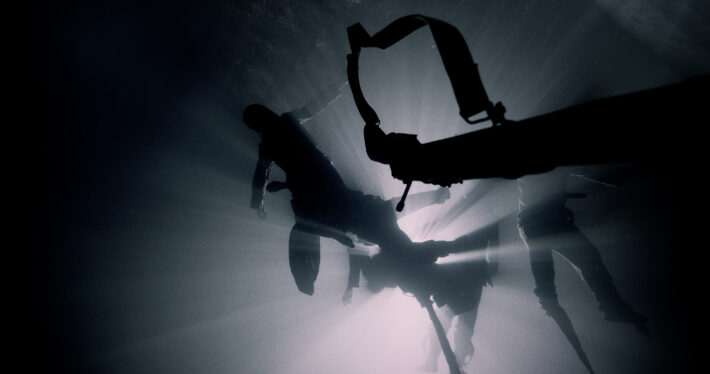
The movie is undeniably grey. It is by no means dull, but it is literally grey. Colours are visible, but just enough, similarly to our protagonists hiding from their opponents. Ironically, sometimes the clearest colour are visible at night and usually when the Red Army soldiers are well-hidden and away from the KMT. The near-black-and-white feel is not just a likely homage to old films of the time; the colour and light adopted throughout the movie are used masterfully to ‘speak’ when no words can be uttered, especially when hiding. Colours not only helped to guide the audience where to look, but they also helped to portray the feeling of despair, confusion, and fear that the protagonists felt (imagine what the actual soldiers must have felt at the time!).
While one may expect a gripping, ticking-time-bomb type of story, grey slows down time while simultaneously maximising fear and confusion. The anxiety may sometimes be invisible but it is clearly palpable. Daytime and night time are slightly different shades of grey and both the audience and the soldiers can find it hard to distinguish between the two. While the soldiers are in a rush to reach their target, light and shadows are both their saviour and danger throughout their journey.
The overall grey palette also makes it difficult to distinguish who is who at times.The uniforms worn by Red Army and KMT soldiers are sometimes indistinguishable, especially at night. The grass is tall and the foliage is thick, optimal conditions for camouflage, and especially for small infantry teams. One can only but ponder how difficult it must have been for soldiers to locate, identify, and aim at their opponent…
The grey palette also renders the background virtually the same. Numerous scenes, such as hiding, fighting, and escaping, occur in vast open environments, such as fields and forests. The viewer can just about tell what shade of green the grass and trees are, let alone for caves, hiding spots, and underwater scenes.
Similarly to the uniforms, the terrain virtually looks the same. And it is here that I kept asking myself: where are the soldiers? Who is whom? Can the viewers tell where the characters are? Can the soldiers in the movie? What is the difference between the soldiers of the two sides? What are the differences between Red Army and KMT terrains and locations?
All I could think about was that everyone and everything was grey; everyone was the same and everything was the same. After all, in a civil war, how can one clearly define and identify which faction one belongs to? The Red Army soldiers would sometimes be identifiable by the pale red tabs on their shirt collars, which were barely visible under daylight. Ironically, these were most often visible at night with only a modest, half-broken, and dim lantern.
The climax about identity occurs towards the end when a KMT soldier, in an effort to convince a Red Army soldier to spare his life, shouts “Please don’t shoot! We’re all the same!”.
Grey successfully neutralises each faction’s identity, cause, and beliefs by essentially making everyone and everything look the same. The only visible and tangible differences were the characters’ words and actions.
The colour scheme together with the cinematography also elevates the soldiers’ anxiety and fear. Sitting in a dark room watching a grey war movie certainly made me feel even more ‘inside’. The theatre became an extension of the battlefield. I, too, was running through the vast, open fields at night trying to escape enemy soldiers and invisible bullets whizzing past my head. I, too, was hiding, quietly, in a cave. I, too, was holding my breath underwater at night. I, too, felt hopelessness, terror, and sadness.
The lack of music for most of the movie certainly raised the tension. So much so that at times Beyond the Skies felt like a horror movie. The fog of war was omnipresent and, sometimes, literally on the battlefield. Shadows would vanish. Bullets would fly by, the shooters hidden or barely visible. Injuries, wounds, and death were vivid, realistic, and raw. The act of killing felt empty and routine-like, but deaths were palpable. Confusion was similarly constantly on everyone’s mind: where is the enemy? Which way to the target? Were enemy soldiers even there? Mocking his comrade, one KMT soldier half-joked that what his comrade must have heard in the water were “ghosts”.
Despite all of these challenges, none were insurmountable. Despite life-threatening wounds, betrayal, numerical and firepower inferiority, and lack of support, the Red Army soldiers battled through every obstacle they faced. But the obstacles they faced were both physical and spiritual: should they keep fighting or retreat? Should they give up? How much is worth sacrificing? What even is their cause in the first place?
Throughout the movie, the main characters of the Red Army find answers to many of these questions. More importantly, they constantly come together despite their near-death experiences. The next step feels like their last, until it isn’t. The protagonists’ perseverance and endurance were simply admirable and awe-inspiring. It is sacrifice in its purest form. It is, moreover, humbling: to give everything, including your life, for a cause, despite constantly being at a disadvantage.
But, most importantly, all of this felt essentially apolitical. The atypical and unexpected lack of political leaders (in words or appearance), slogans, and ideology, the audience is simply drawn to the human element of the story and their characters. Each character not only represents a different element of society (youth, old, men, women, soldiers, civilians), but their efforts are also a reflection of their human spirit rather than a political pursuit. Theirs is a battle for survival, for identity, for loyalty, for hope, for camaraderie, for commitment to the cause. Despite their use of lethal force, the protagonists still showed respect, dignity, and humanity for their ‘enemy’ – whether feeding a prisoner and talking to them as a fellow compatriot, avoiding shooting without having their target in sight, sparing one’s life, or digging a grave for a fallen comrade with your bare hands.
Beyond the Skies’s greatest accomplishment, in my view, is telling historically-charged and highly politicised events through a purely human lens. Beyond the Skies does not ask the audience ‘who’, but, rather, ‘what’: what is worth sacrificing? What is the purpose? What is right? Beyond the Skies, after all, depicts the two main sides of the Chinese Civil War which have, since 1949, been separated by the Taiwan Strait. And so, I ask: what does Beyond the Skies mean for China and Taiwan today? What does it mean to be ‘Chinese’ today? Are the differences and divisions so ‘black and white’, or is everything ‘grey’? What are the values, not just political, of contemporary Chinese identity? What is worth sacrificing in war?
These are some of the questions that I have been asking myself since I left the theatre. History can be a guide and it can teach us about the present, but it is no crystal ball. No one can predict the future, but answering some of these questions, perhaps, will help us understand what future we will have.
About the author
Richard C. (not his real name) is a volunteer for NüStories in London.