BY ANGEL SUN
During the massive Hong Kong protests in 2019, “people braved endless rounds of tear gas, water cannons, and rubber and live bullets with peace marches, barricades, Molotov cocktails, and trench warfare,” recalls Forever Hong Kong: A Global City’s Decolonisation Struggle.
Triggered by the proposed extradition bill, the demonstrations evolved into a broader anti-Beijing movement calling for democracy, only to subside abruptly with the arrival of the COVID-19 pandemic. Since then, the city’s political climate has darkened: the National Security Law was imposed, tens of thousands emigrated, and hundreds of politicians, journalists, and activists were arrested. By 2025, publications about Hong Kong no longer focused on the street battles themselves, but on their meaning and aftermath, often with a tone of deep pessimism.
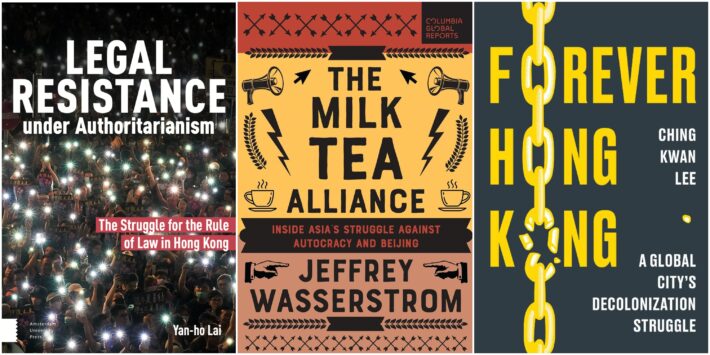
Three recent books take markedly different approaches to Hong Kong’s 2019 movement and its legacy: Yan Ho Lai’s Legal Resistance under Authoritarianism: The Struggle for the Rule of Law in Hong Kong, Ching Kwan Lee’s Forever Hong Kong: A Global City’s Decolonisation Struggle, and Jeffrey Wasserstrom’s The Milk Tea Alliance: Inside Asia’s Struggle Against Autocracy and Beijing.
Law and Resistance
In Yan Ho Lai’s Legal Resistance under Authoritarianism: The Struggle for the Rule of Law in Hong Kong, on perspective that is perhaps the most original of the three, the protests are examined through the eyes of lawyers rather than protesters — a fresh perspective given how much attention media has devoted to the latter. A research fellow at Georgetown’s Center for Asian Law, Lai explores how Hong Kong’s legal community resisted authoritarian encroachment and navigated the tension between professional restraint and political activism from 2014 to 2020.
Lai argues that Hong Kong’s rule of law emerged from the uneasy blend of British colonialism and Chinese authoritarian legal transplantation. Educated in common law and liberalism yet professionally dependent on Beijing’s system, Hong Kong lawyers found themselves caught between two worlds. The book traces how activist lawyers sought to empower civil society — decentralising legal knowledge, contesting pro-Beijing leadership, and providing legal aid to protesters.
Drawing on colonial history, industry statistics, and interviews with frontline lawyers, Lai comprehensively unpacks the moral and professional conflicts within one of Hong Kong’s most respected social classes. Despite its academic tone, the book offers an incisive and revealing portrait of legal resistance under pressure.
Decolonising the Self
Ching Kwan Lee’s Forever Hong Kong: A Global City’s Decolonisation Struggle adopts a more accessible, narrative-driven approach. Rather than rehashing the familiar story of resistance against Beijing, Lee explores Hong Kongers’ effort to decolonise from China itself, politically and culturally, through interviews with activists and ordinary citizens involved in 2019.
Lee begins with a vivid recounting of Hong Kong’s colonial history and the emergence of a distinct local identity. Her tone carries a touch of nostalgia for the city’s once-liberal past. The heart of the book lies in the interviews, which trace how individuals’ understanding of democracy evolved between 2014 and 2019.
Her storytelling approach — including full interview transcripts — makes the text occasionally repetitive for local readers but highly accessible to international audiences. Combining engaging language with a light decolonial framework, Forever Hong Kong succeeds as both chronicle and reflection on a city redefining itself under tightening control.
A Regional Solidarity
The most concise of the three, Jeffrey Wasserstrom’s The Milk Tea Alliance: Inside Asia’s Struggle Against Autocracy and Beijing, situates Hong Kong’s movement within a broader Asian context. In April 2020, netizens from Hong Kong, Bangkok, and Taipei — all famed for their sweet milk tea — forged an online solidarity network: the Milk Tea Alliance.
Using this phenomenon as a lens, Wasserstrom, Chancellor’s Professor of History at the University of California, Irvine and a sinologist who studies youth activism, compares democratic movements in Thailand, Hong Kong, and Myanmar. Focusing on three activists — Netiwit Chotiphatphaisal, Agnes Chow, and Ye Myint Win — he highlights their shared youth-driven energy, creative use of pop culture (such as The Hunger Games), and cross-border support.
Wasserstrom justifies his choice of subjects for their cultural diversity and limited prior comparison. His inclusion of Myanmar’s participation, often overlooked by mainstream media, adds welcome depth. He vividly depicts how the activists interacted with Hong Kong’s Joshua Wong, exchanging gestures of solidarity. The book could, however, have delved more deeply into the transnational side of Agnes Chow’s activism — from her 2012 involvement in the Anti-National Education Movement to her symbolic role as a female resistance icon. Today, Chow lives in self-imposed exile in Canada, while Wong remains imprisoned under the National Security Law, due for release in 2027.
Shared Threads
Despite differing methods and tones, all three books affirm that Hong Kong’s pro-democracy struggle did not begin in 2019. Its roots stretch back through colonial-era inequities and Beijing’s expanding influence after 1997. Earlier flashpoints — Beijing’s first attempt to introduce the National Security Law in Hong Kong in 2003, the Anti-National Education Movement in 2012, and the 2014 Umbrella Revolution — all shaped public consciousness long before the 2019 uprising.
Together, these works highlight Hong Kong’s civil society as a tapestry of individual stories: lawyers risking prestige to defend liberal values; middle-aged citizens embracing once-taboo protest tactics; women confronting sexism within the movement; and exiled activists wrestling with disillusionment abroad. Their intertwined struggles form the living web of bottom-up activism that defined 2019 — and continues to echo worldwide amid a new wave of Gen-Z resistance.
In showing the human complexity behind Hong Kong’s protest movement, these books remind readers that democracy’s story, even under repression, is never truly finished.
About the writer
Angel Sun is a freelance journalist passionate about human-interest and long-form feature writing in both Chinese and English. Her work, mainly exploring East Asian diaspora and gender issues, has appeared in Initium Media. She also writes film reviews for The Indiependent and news articles for British local newspapers like Hackney Gazette. She is deputy social editor at NüVoices. View her portfolio and LinkedIn as a fresh journalist here.
About the editor
Lijia Zhang is a factory-worker-turned writer, social commentator and public speaker. Her articles have appeared in The Guardian, The South China Morning Post, Newsweek, and The New York Times. She is the author of the critically acclaimed memoir “Socialism Is Great!” and her debut novel Lotus follows a prostitute in China. Lijia has lectured at many conferences, institutions and universities around the world. She is a regular speaker on the BBC, Sky TV, CNN and NPR.